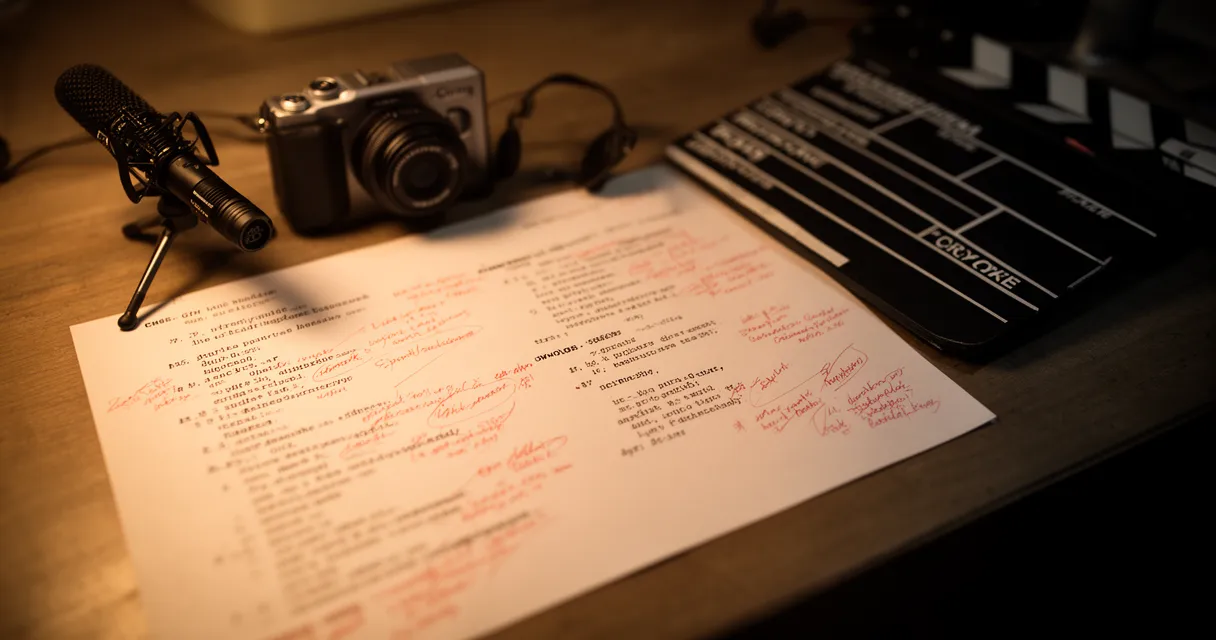
Staring at a blank document, wondering how professional YouTubers make scripting look so effortless?
Writing your first video script can feel overwhelming—you’re not sure how to structure your ideas, how long it should be, or how to keep viewers watching until the end. The fear of rambling on camera or losing your audience’s attention is real.
This beginner-friendly guide breaks down the entire video script writing process into 7 actionable steps, complete with templates, timing formulas, and real examples you can use today. By the end, you’ll have a clear roadmap to transform your scattered ideas into a polished, engaging script.
Quick Answer: A video script should follow a clear structure: hook (first 5-10 seconds), intro (problem + promise), body (main content in logical sections), and outro (recap + CTA). Aim for 130-150 words per minute of video, write conversationally, and use a two-column format to align audio with visual cues.
Why Every Video Needs a Script (Even ‘Casual’ Ones)
You might think scripts are only for formal corporate videos, but that couldn’t be further from the truth.
According to TechSmith’s 2026 Video Statistics, 57% of viewers say clarity is the most important factor in keeping them engaged. Without a script—even a simple bullet-point outline—your content can quickly become disorganized, causing viewers to click away.
Scripts serve three critical purposes:
- Prevent rambling and keep you focused on your core message
- Improve viewer retention by maintaining a logical flow
- Save editing time by reducing filler words and long pauses
Even if you prefer a more conversational style, having a script as your foundation means you can deviate naturally while staying on track. Think of it as your safety net, not a straitjacket.
Step 1: Define Your Video Goal and Audience
Before you write a single word, you need clarity on two things: who you’re talking to and what you want them to do.
A script without a clear goal becomes a meandering information dump. Your viewers won’t know what to take away, and you’ll struggle to create a focused narrative.
Start by answering these questions:
- Who is this video for? Are they complete beginners, intermediate learners, or experts?
- What problem are you solving? What frustration or question brought them here?
- What action should they take? Subscribe, buy, learn a skill, change their mindset?
Quick Exercise: Fill in the Blanks
Use this simple template to sharpen your focus:
“This video will help [audience] to [accomplish goal] so they can [desired outcome].”
Example: “This video will help aspiring YouTubers to write their first video script so they can film confidently without rambling.”
When your goal is crystal clear, every section of your script will support that single objective.
Step 2: Create Your Script Outline First
Here’s the biggest mistake beginners make: jumping straight into writing the full script without an outline.
An outline is your blueprint. It prevents you from creating disorganized, overstuffed videos that try to cover too much at once. Without one, you’ll likely go off on tangents or forget key points entirely.
Start with the classic beginning, middle, end framework:
- Beginning: Hook + intro (who this is for, what problem you’re solving)
- Middle: 3-5 main points that support your goal
- End: Recap + clear call to action
List out the 3-5 core points you absolutely must cover. Everything else is optional.
Beginner Outline Template
1. Hook (5-10 seconds)
2. Intro (30-45 seconds)
   - State the problem
   - Promise the solution
3. Main Point 1 (1-2 minutes)
4. Main Point 2 (1-2 minutes)
5. Main Point 3 (1-2 minutes)
6. Recap (20-30 seconds)
7. CTA (10-15 seconds)
Example for a 5-minute “How to Edit Photos” video:
- Hook: “Your photos look dull because you’re skipping this one step”
- Intro: Promise to show 3 quick fixes
- Point 1: Adjust exposure properly
- Point 2: Use color grading
- Point 3: Sharpen strategically
- Recap: Quick review of all 3
- CTA: “Try these on your next photo and tag me on Instagram”
This outline takes 5 minutes to create but saves you hours of rewriting.
Step 3: Write a Hook That Stops the Scroll
You have more viewers in the first 10% of your video than at any other point. That’s your window to prove this video is worth their time.
Your hook needs to do one thing: make them think, “This is exactly what I need right now.”
Keep your hook under 10 seconds—that’s about 15-25 words. Any longer and you risk losing impatient viewers before you’ve even started.
5 Hook Formulas That Work
1. The Question Hook ❌ Bad: “Do you want to learn photography?” ✅ Good: “Why do your photos look flat while others’ pop off the screen?”
2. The Bold Statement Hook ❌ Bad: “I’m going to teach you about marketing.” ✅ Good: “Most beginner marketers waste 80% of their budget on the wrong channels.”
3. The Quick Win Hook ❌ Bad: “This video is about productivity tips.” ✅ Good: “This 2-minute morning habit doubled my productivity—here’s how.”
4. The Relatable Problem Hook ❌ Bad: “Some people struggle with public speaking.” ✅ Good: “Your palms sweat, your mind goes blank, and you forget everything you planned to say.”
5. The Curiosity Gap Hook ❌ Bad: “I’m going to show you a cooking technique.” ✅ Good: “Professional chefs use this 30-second trick to make restaurant-quality sauces at home.”
Notice the difference? Good hooks are specific, relatable, and immediately valuable.
Step 4: How to Structure a Video Script (The Body)
This is where your main content lives—the meat of your video that delivers on the promise you made in your intro.
Break complex topics into bite-sized, digestible sections. Each section should cover one clear idea before moving to the next. Use transition phrases like “Next up,” “Now that you understand X,” or “Here’s where it gets interesting” to guide viewers smoothly between points.
According to Verstiuk’s 2026 Video Research, the average viewer retention of a 1-2 minute video is 57%, and retention drops significantly after the one-minute mark. This means your structure needs to deliver value quickly and maintain momentum.
The Two-Column Script Format
Professional video creators use a two-column format to align what they say with what viewers see.
Audio Column (Left): What you’ll say word-for-word or as bullet points Video Column (Right): What appears on screen—b-roll footage, text overlays, graphics, screen recordings
Example:
| AUDIO | VIDEO |
|---|---|
| ”The first step is to open your editing software and import your footage.” | Screen recording of software opening + footage being dragged into timeline |
| ”You’ll notice the clips appear in the timeline at the bottom.” | Zoom in on timeline, highlight with arrow graphic |
| ”This is where the magic happens.” | Cut to talking head with excited expression |
This format keeps you organized during filming and makes editing exponentially easier. You’ll know exactly what visuals to capture or create for each line of your script.
How to Calculate Script Length
Here’s the math that will save you from writing scripts that are too long or too short.
The average speaking rate is 130-150 words per minute in a natural, conversational tone (Vidyard Script Timer 2026). Some creators speak faster when excited, others slower for complex topics, but 140 words per minute is a safe middle ground.
Formula: Target video length (in minutes) × 140 words = script word count
Examples:
- 1-minute video: 140 words
- 3-minute video: 420 words
- 5-minute video: 700 words
- 10-minute video: 1,400 words
Count your words in Google Docs (Tools → Word count) or use any word processor. If you’re significantly over or under, adjust before filming—it’s much easier than trying to speed up or slow down your delivery later.
Step 5: Write Like You Talk (Not Like an Essay)
The fastest way to bore your audience? Sound like you’re reading from a corporate manual.
Video scripts need to feel conversational, like you’re talking to a friend. That means using contractions, casual language, and even the occasional sentence fragment for emphasis.
The test: Read your script aloud. If you stumble over phrases or sound stiff, rewrite those sections. Your script should flow naturally when spoken, not just when read silently.
Avoid jargon unless your audience expects it. If you’re making a video for software developers, technical terms are fine. If you’re teaching general cooking skills, “emulsification” might need to be “blending ingredients until smooth.”
Before and After Examples
Formal (❌): “In this tutorial, we will examine the fundamental principles of effective time management and explore various methodologies that can be implemented to enhance productivity.”
Conversational (✅): “Let’s talk about how to actually get stuff done without feeling overwhelmed all the time.”
Formal (❌): “It is essential that one considers the implications of poor sleep hygiene on overall health outcomes.”
Conversational (✅): “Bad sleep habits will mess up your health—here’s why it matters.”
See the difference? The conversational versions are shorter, punchier, and sound like a real person talking. That’s what keeps viewers engaged.
Step 6: Add Visual Cues and B-Roll Notes
Your script isn’t just about what you say—it’s about what viewers see while you’re saying it.
Adding visual cues to your script keeps you organized during filming and editing. You’ll know exactly what footage to capture, what graphics to create, and where to add text overlays.
Mark these visual elements directly in your script:
- [B-ROLL: Coffee brewing in slow motion] — Note what supplementary footage to show
- [TEXT OVERLAY: “30% increase in productivity”] — Highlight key stats or quotes
- [GRAPHIC: Comparison chart] — Show when to display diagrams or illustrations
- [SCREEN RECORDING: Navigate to Settings] — For tutorial videos, note what to record
Example script section with visual notes:
“The secret to perfect coffee is actually the water temperature. [B-ROLL: Thermometer in kettle] Most people boil water and immediately pour it over the grounds. [B-ROLL: Steam rising from cup] But water that’s too hot extracts bitter compounds. [TEXT OVERLAY: Ideal temp = 195-205°F] Let your water cool for 30 seconds after boiling.”
This level of detail makes production smooth and ensures you don’t forget critical visual elements.
Step 7: Craft a Strong Conclusion with Clear CTA
Your conclusion has two jobs: remind viewers what they learned and tell them what to do next.
Too many beginners let their videos fizzle out with a weak “Thanks for watching.” That’s a wasted opportunity to drive action and build community.
Recap your main points in 2-3 sentences—just the highlights, not a detailed summary. Then include one clear call to action (CTA). Multiple CTAs confuse viewers and dilute your results.
CTA Examples by Video Type
Educational/Tutorial Videos: “Now you know the 3 steps to fix your sleep schedule. Try them tonight and let me know in the comments which one helped most.”
Product Review Videos: “If you’re ready to upgrade your setup, I’ve linked my favorite budget-friendly option below. Use code SAVE10 for 10% off.”
Vlog/Lifestyle Videos: “That’s how I spent my week learning to surf. If you want more travel adventures, hit subscribe—I post every Thursday.”
How-To Guides: “You’ve got the script template, the timing formula, and real examples. Your next step? Learn how to properly format your video script so it’s easy to read on camera.”
End with a question or next step to boost engagement. Questions drive comments, and comments signal to YouTube that your content is engaging.
Common Video Script Mistakes Beginners Make
Even with a solid template, it’s easy to stumble. Watch out for these pitfalls:
1. Writing too much for the video length If you’re creating a 3-minute video but your script is 800 words, you’ll either have to rush through it (sounding frantic) or cut content on the fly (losing structure). Stick to the 130-150 words per minute rule.
2. Forgetting to hook viewers in the first 5 seconds Starting with “Hey guys, welcome back to my channel” wastes your most valuable seconds. Jump straight into the value: the problem you’re solving or the promise you’re making.
3. Using formal, stiff language instead of conversational tone If you wouldn’t say it to a friend over coffee, don’t write it in your script. Read everything aloud before filming.
4. No clear structure or logical flow between points Jumping randomly between topics confuses viewers. Use your outline to ensure each section builds on the last, and add transition phrases to connect ideas smoothly.
5. Not planning for visuals If your script is just a wall of text with no visual notes, you’ll forget to capture b-roll or graphics. This makes editing harder and results in boring “talking head” footage with nothing to support your points.
Free Video Script Template for Beginners
Ready to write your first script? Copy and customize this video script template for beginners for immediate use.
VIDEO SCRIPT TEMPLATE (Two-Column Format)
Video Title: [Your working title]
Target Length: [X minutes]
Word Count Target: [X minutes × 140 = Y words]
| AUDIO | VIDEO |
|---|---|
| HOOK (5-10 seconds, 15-25 words) | |
| [Question, bold statement, or relatable problem] | [Visual: Compelling opening shot] |
| INTRO (30-45 seconds, 70-105 words) | |
| [State the problem your audience faces] | [Visual: B-roll showing problem] |
| [Promise what you’ll deliver in this video] | [Visual: Talking head or text overlay with promise] |
| [Quick preview: “Here’s what we’ll cover…”] | [Visual: List items or numbered points] |
| MAIN POINT 1 (1-2 minutes) | |
| [Explain concept with examples] | [Visual: B-roll, screen recording, graphics] |
| [Add specific tips or steps] | [Visual: Text overlays for key points] |
| MAIN POINT 2 (1-2 minutes) | |
| [Continue teaching/explaining] | [Visual: Relevant footage or demonstrations] |
| MAIN POINT 3 (1-2 minutes) | |
| [Final key point] | [Visual: Supporting visuals] |
| RECAP (20-30 seconds, 45-75 words) | |
| “So to recap: [Point 1], [Point 2], [Point 3]“ | [Visual: Quick montage or list] |
| CTA (10-15 seconds, 20-35 words) | |
| [Clear action: subscribe, comment, click link, try technique] | [Visual: End screen with subscribe button] |
Total Word Count: [Check against target]
Save this template and use it every time you plan a new video. Adjust section lengths based on your specific content, but keep the core structure intact.
Tools to Speed Up Your Script Writing Process
Here’s a reality check: 49.8% of marketers now use generative AI to generate script outlines and ideas (RecurPost 2026 YouTube Statistics). You’re not cheating by using tools—you’re working smarter.
AI-powered tools can help you overcome the dreaded blank page, generate multiple hook variations, calculate optimal script length instantly, and suggest structural improvements based on proven frameworks.
Popular AI tools for video script writing:
- ChatGPT — Generate outlines, brainstorm hook ideas, and refine conversational tone
- Claude — Create detailed script structures and get feedback on pacing
- Copy.ai — Specialized templates for different video types (tutorials, reviews, vlogs)
- Jasper — Video script templates with built-in SEO optimization
These tools work best when you provide clear prompts. Instead of “write a video script about coffee,” try “create a 3-minute video script outline for beginner home coffee brewing, targeting millennials who want café-quality results without expensive equipment.”
Other helpful tools:
- Vidyard Script Timer — Paste your script and see estimated video length
- Google Docs — Free, cloud-based writing with automatic word count
- Notion or Airtable — Organize multiple script ideas and track production status
The key? Use AI to generate ideas and structure, but add your unique voice and expertise. Your personality and authentic insights are what make your content stand out, not perfectly polished AI-generated text.
When you’re ready to promote your videos and build your audience, knowing how to write engaging YouTube descriptions will help your content get discovered.
Frequently Asked Questions
What is the best way to structure a video script?
Use this proven structure: Hook (5-10 seconds) → Intro with problem and promise → Main content in 3-5 clear sections → Recap + CTA. The two-column format (audio on the left, visual cues on the right) keeps your spoken content aligned with what viewers see on screen, making production and editing significantly easier.
How long should a video script be?
Aim for 130-150 words per minute of video. For a 5-minute video, write 650-750 words. Adjust based on your pacing—complex topics need slower delivery around 120 words per minute, while energetic, upbeat content can hit 160+ words per minute. Always time yourself reading the script aloud before finalizing it.
Do you need a script for YouTube videos?
Yes, even if it’s just bullet points or a structured outline. 57% of viewers say clarity is the most important factor for staying engaged (TechSmith 2026). Scripts prevent rambling, improve viewer retention, and help you deliver your message confidently without losing your train of thought or forgetting key points.
How many words should a video script have?
Use this formula: video length in minutes × 140-150 = target word count. Examples: 150 words for 1 minute, 300 words for 2 minutes, 700 words for 5 minutes, 1,400 words for 10 minutes. This assumes a natural, conversational pace. Test by reading your script aloud and timing yourself.
What format should I use for a video script?
Use a two-column format: the left column contains audio (what you’ll say), and the right column contains video notes (what viewers will see—b-roll, text overlays, graphics, screen recordings). This format keeps your visual and audio elements aligned, making filming smoother and editing faster.
Conclusion
You now have everything you need to write a compelling video script for beginners.
Start with a clear goal and outline before writing a single word. Hook viewers in the first 10 seconds with a question, bold statement, or relatable problem. Write 130-150 words per minute in a conversational tone that sounds natural when spoken. Use the two-column format to align your audio with visual cues. End with a clear CTA and always practice reading your script aloud before filming.
The difference between rambling on camera and delivering a polished, engaging video comes down to preparation. Following this guide on how to write a video script for beginners gives you the exact framework professional creators use—now it’s your turn to put it into action.
Ready to take your YouTube channel to the next level? Check out our comprehensive YouTube success guide for everything from optimization to growing your subscriber base.